Posts

Seth Thomas #120

Image
 In for repair is a Seth Thomas number 120 mantle clock movement.  Only the movement was given.  There was no pendulum bob.  The work begins......... The image below shows the front plate before any work has been completed.  The mainspring power would be let down and wheels rotated to see how much wear is present in each wheel.  See below for a short video demonstrating the wear. Back plate Front plate partially disassembled.  Mainspring plate and wheels removed along with the front motion works and levers removed.  As you can see the worn pivots holes were marked.  There were 5 pivot holes on the front plate that needed rebuilding and 7 holes on the back.  12 in total. Back plate marked.  Click this image below to display a short video of the pivot hole wear This image shows the front plate removed and the location of all the wheels. The video below demonstrates a clock wheel after the pivot was polished and the pivot hole was rebu...

French Picture Clock

Image
  Set of three movements on board Front Plate Front Plate with partial lever removed Top plate removed Back plate Front plate showing the amount of dirty oil in pivot holes Broken Suspension  The suspension was a thread like material.  To regulate the clock there is a keyed arbor that wraps the thread materal around the arbor thus making the suspension loop longer or shorter. Damaged mainspring end.  The mainspring end was chiped and down at the bottom of the hole the material is cracked.  This must be rebuilt.  About one inch of the  mainspring was removed.  The end heated and tempered.  From there a hole was punched and filed to size. Repaired Mainspring End.  This image is not the finished product.  As you can see the hole was not centered.  This was corrected with a little more fileing. The barrel was repaired by a previous repairman.  This image shows the repair After all the repair work was completed.  The movem...

Cuckoo Clock - Musical

Image
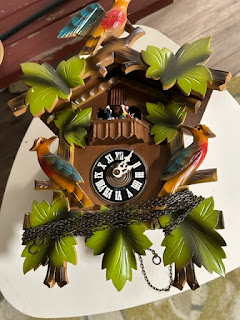
 In for repair is a 3 weight cuckoo clock.  The movement is made by the German company Regula.  This is a 30 clock to be wound every day.  The case is in fairly good condition.  The movement has been repaired at least a couple times.  The repair methods in my opinion are questionable.   A nice looking musical cuckoo with dancers The clock movement removed from the case.  Note the red lines pointing to the pivot holes needed attention.  There were 5 worn holes on the back plate and 4 holes on the front for a total of 8 pivot holes needing rebuilding.  The label A shows a bushing placed on the strike side.  Note that there was a problem with the installation of the bushing.  This is seen by the solder used to keep the bushing in place.  The B label and the pivot hole below B was repaired by crowding the brass metal into the hole to close the diameter of the hole to keep the wheel from shaking back and forth.  ...

Waterbury Clock with Extreme Pivot Wear

Image
In for repair is a Waterbury steeple clock with alarm and pendulum indicator bob.   When it was brought into the shop, the customer provided information about a slipping/grinding sound coming when the minute hand was manually adjusted.  The clock is in nice condition given the age of the clock.  An estimate for this particular clock is about 1885.  A short history of the Waterbury Clock Company can be found by following this link .  Below is a picture of this nice clock: After the clock movement was taken out of the case, it was obvious what the problem is.  Follow this link for a short video of the excessive wear.  The customer stated and I proved it that the clock still runs.  This is also a verification that these American time & strike clocks are overpowered, i.e., the mainsprings are too strong.   Another interesting tid-bit of this previous repair was the clock was worn out a long time ago and the previous repair person c...

Kienzle Wall Clock

Image
In for repair is a german wall clock made by the Kienzle Company.  There were no markings on the clock movement except for the Kienzle stamp.  This short history of the Kienzle factory was taken from various links from Wikipedia:  Kienzle Factory and History . Here is the clock as it came into the shop.  At the bottom of the case was a wood screw (A).  When first arrived I had to scratch my head wondering if this screw really belonged to the clock.  Upon further disassembly, it was one of two screws that secured the chime rod block.  The chime rod (B) was loose and just sitting at the bottom of the clock.  Before disassembly, the thought the chime rod was broken.  It was not, the chime block was not attached to the case.  (C) loose glass on the side of the case.  This needed some TLC. The chime rod and block repair is depicked in these next two images.  As stated above, there was one wood screw in the case but not a 2nd screw....

Sympathetic Vibration and what causes it

Describing Pendulum bob magnetism  Make sure if your building a stand that it is strong enough to take the weight is one thing, building a test stand that is rigid enough to prevent it flexing is another. Here is an explanation you can pass to your customer to convince him. Sympathetic vibration happens when two pendulums are connected via their suspension points, and one is set in motion. Some of that motion will be transferred to the other pendulum by tiny movements of the mounting board. If the natural period of the two pendulums is different then there is little significant effect. However if the two pendulums have the same natural period (i.e. are the same length) the mutual effect on each other is magnified greatly, and may eventually stop the clock. (Note that as far as the physics of the matter is concerned a drive weight hanging on a line is just another pendulum.) Therefore to prevent  Sympathetic vibration  stopping the clock, the seat board and/or the case mus...

Cuckoo Clock Setup Instructions - Text from Bavarian Clock Works

Image
  CUCKOO CLOCK SET UP: 1.       Hang the clock level on the wall using an anchor rated for 50lbs or more. See anchoring your cuckoo clock in section below. 2.       Carefully unwrap the chains underneath the clock and lower them to the floor so they are hanging free of one another 3.       Unlatch the cuckoo door 4.       Hang the pendulum on the clock, attach the weights, then wind the clock by pulling each weight up to the base of the clock. 5.       Push the pendulum to one side or the other and release it to start the clock. 6.       To confirm that your cuckoo clock is operating correctly advance the minute hand clockwise to the nearest hour or half hour and listen for the cuckoo and music for musical clocks. Be sure to let the cuckoo and music run its full cycle before advance the minute hand again. You can repeat th...